
AI-Powered Development: Building a Freelance Time Tracker Without Writing Code
⁕ CLIENT
For Funsies
⁕ TASKS
app development coded entirely by ai
⁕ TOOLS
claude.ai
⁕ About
Over the weekend, I embarked on an experiment to test Claude.ai's coding capabilities - and the results exceeded my expectations. I developed a fully functional browser-based time tracking application with over 3,000 lines of code, without writing a single line myself.
What made this particularly remarkable was my approach: I never dove into the project structure or examined the codebase directly. Instead, I guided the entire development process purely through natural language prompts, treating Claude as my development partner.
The Application
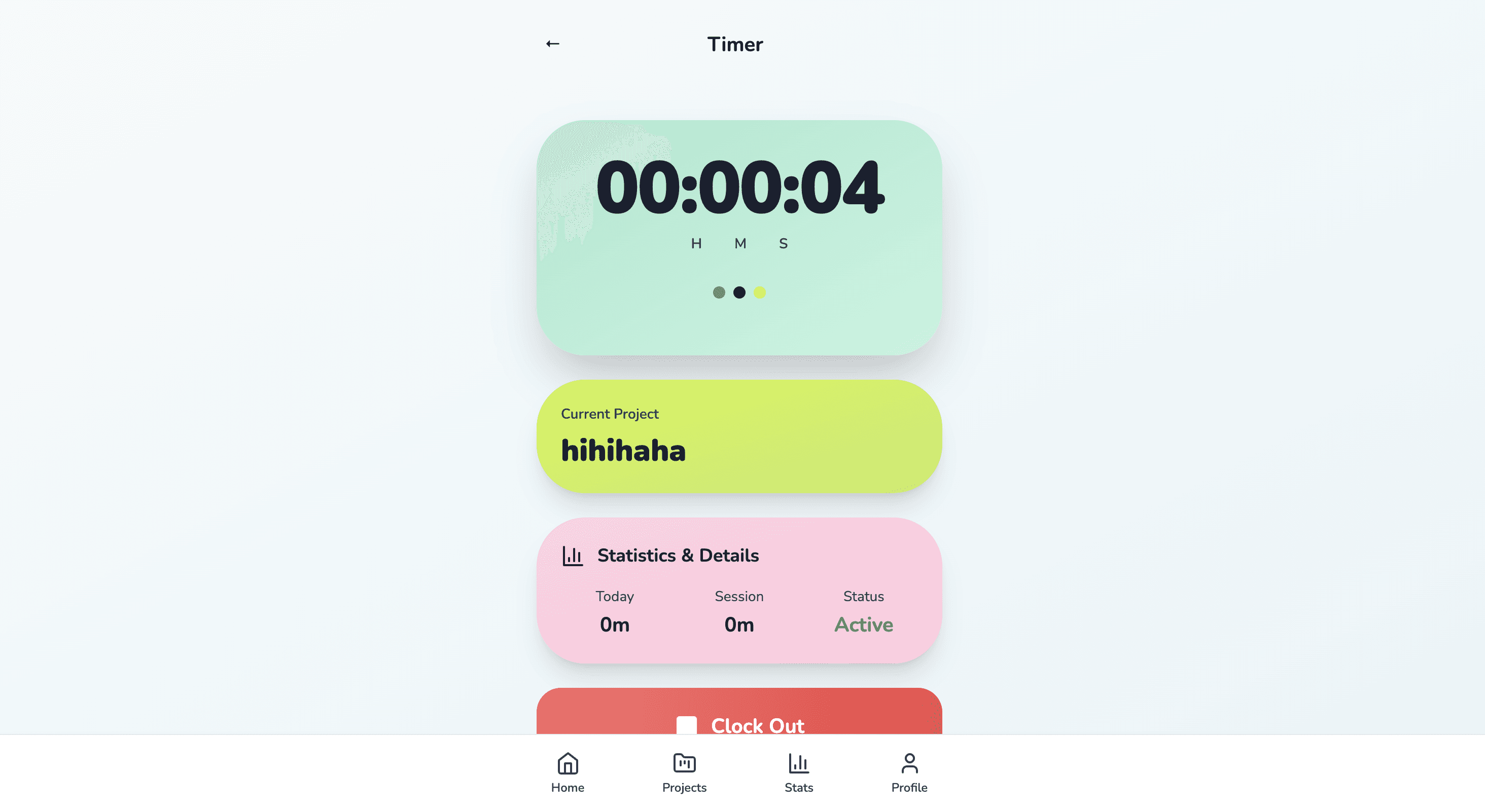
The result is a comprehensive time tracking tool designed specifically for freelancers, featuring:
Multi-project management: Track time across different projects for various clients
Organized client workflows: Keep client work separated and easily accessible
Automated invoicing: Generate professional invoices based on tracked time and project data
Browser-based simplicity: No installation required - everything runs directly in the browser
⁕ Challenge
Challenges: The Reality of AI-Assisted Development
While the end result was impressive, the journey revealed both the capabilities and limitations of current AI development tools.
Multi-Phase Development & Token Limitations
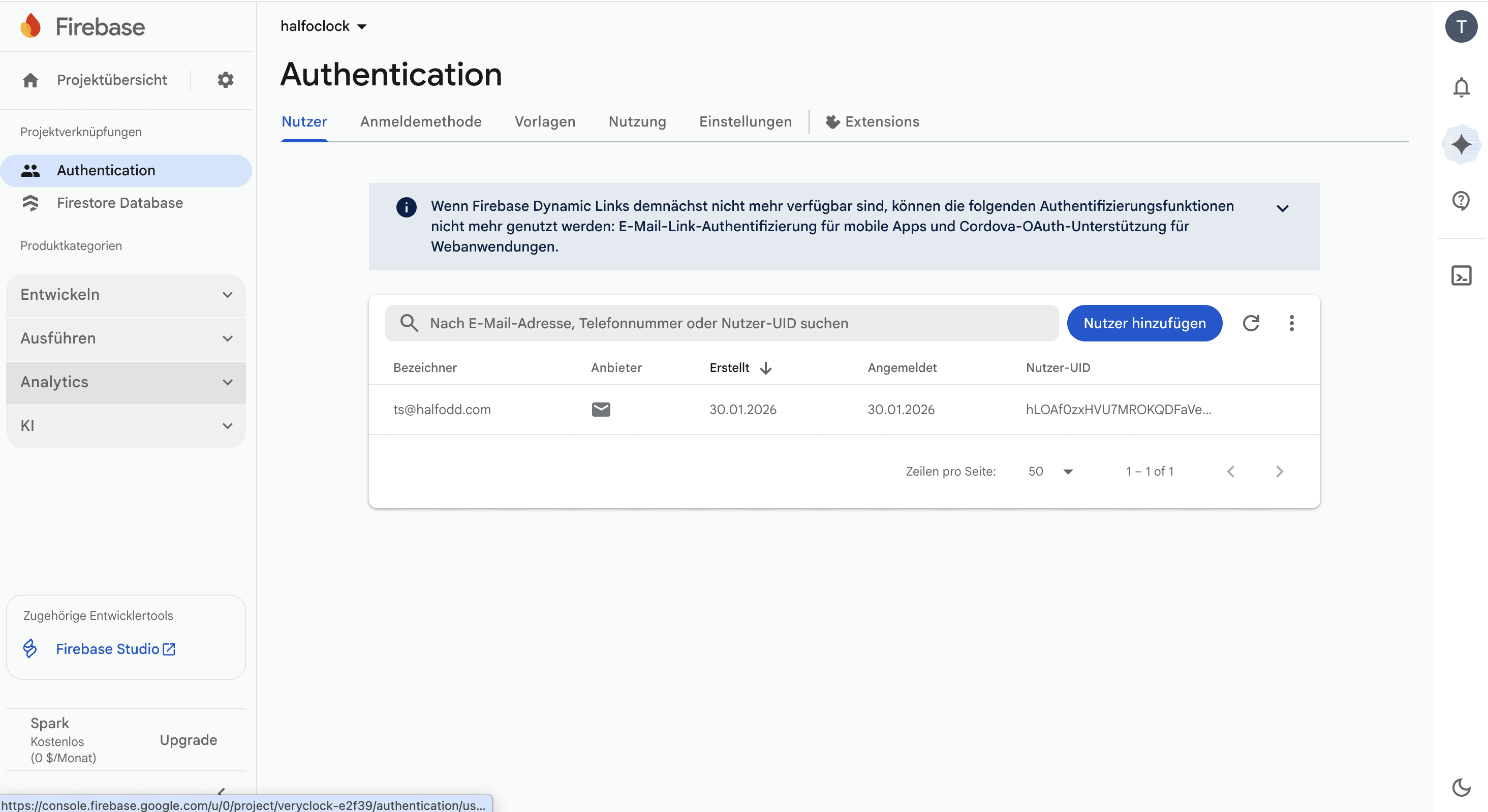
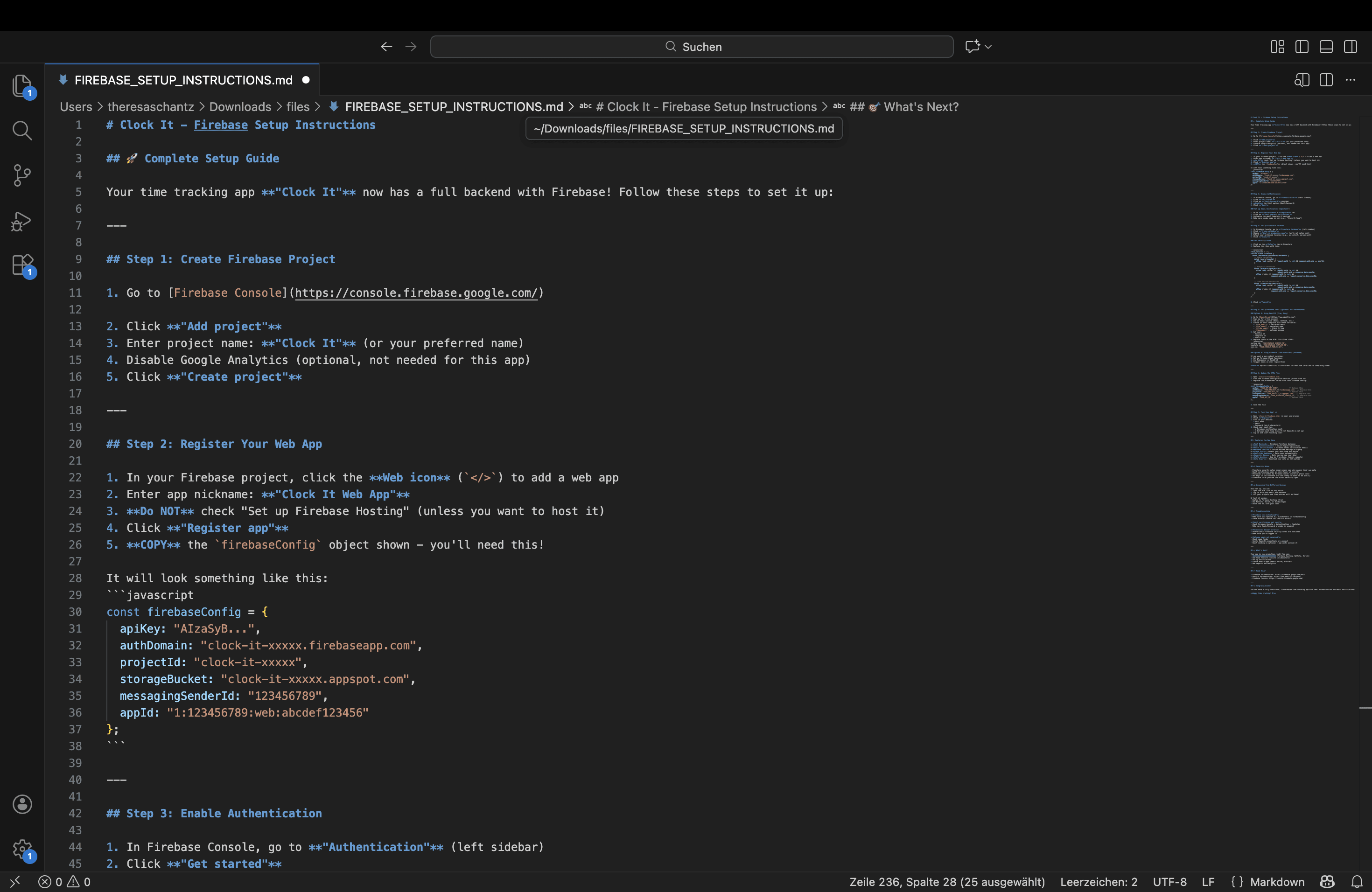
The project quickly proved too extensive for a single development session. Claude and I collaborated to create a comprehensive prompt that outlined all desired features, but we immediately realized the scope was beyond what could be accomplished in one go. We broke the development into three distinct phases:
Each phase required starting a fresh Claude chat to generate the code
The original chat provided detailed prompts for the new sessions
After each phase, I returned to the original chat to sync progress and plan next steps
This workflow emerged from hitting conversation token limits - a constraint that forced me to architect the development process itself.
Plan Restrictions & Timing Constraints
Using Claude's smallest paid plan added another layer of challenge. When response length limits were reached, development had to pause. I'd close the chat and return five hours later when the limits reset. This turned what could have been a marathon coding session into an intermittent, patience-testing process that stretched across the entire weekend.
The "Three-Times Rule"
Some feature requests required multiple attempts before Claude fully understood the requirement. For example:
Making invoices editable after generation took three separate requests to implement correctly
Getting edit forms to pre-populate with existing data as placeholders required similar iteration
These weren't failures - they were conversations. Each refinement brought us closer to the intended functionality, revealing that AI-assisted development isn't just about giving instructions, but about collaborative problem-solving through dialogue.
⁕ Results
Across three development phases, I generated 19 versions before reaching the final, fully functional application. The actual development time totaled approximately 5 hours (though elapsed time was longer due to token resets). During Claude's processing and waiting periods, I started rewatching How to Get Away with Murder, turning forced breaks into productive multitasking.
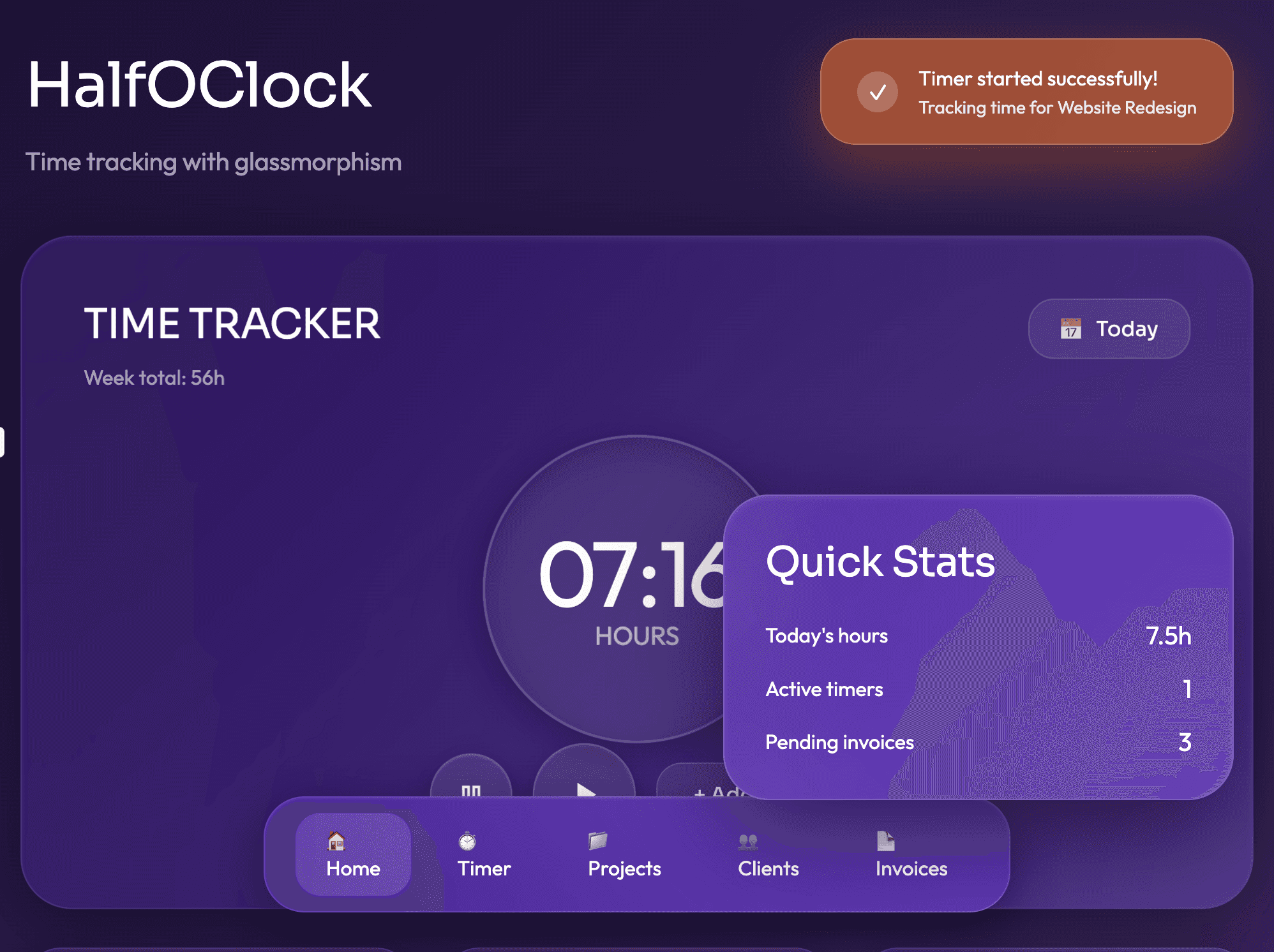
The final product delivers all envisioned features: comprehensive time tracking, multi-client management, and automated invoicing; all from 3,000+ lines of code I never wrote or reviewed. What emerged was both a functional freelancer tool and proof that AI-assisted development can fundamentally transform how solo developers build software.
However, even though the app is fully functioning, there are still many improvements to be made. The next obstacle to be tackled is the design of the interface and I can't wait to explore claudes abilities to do so.
© Half odd
AI-Powered Development: Building a Freelance Time Tracker Without Writing Code
⁕ CLIENT
For Funsies
⁕ TASKS
app development coded entirely by ai
⁕ TOOLS
claude.ai
⁕ About
Over the weekend, I embarked on an experiment to test Claude.ai's coding capabilities - and the results exceeded my expectations. I developed a fully functional browser-based time tracking application with over 3,000 lines of code, without writing a single line myself.
What made this particularly remarkable was my approach: I never dove into the project structure or examined the codebase directly. Instead, I guided the entire development process purely through natural language prompts, treating Claude as my development partner.
The Application
The result is a comprehensive time tracking tool designed specifically for freelancers, featuring:
Multi-project management: Track time across different projects for various clients
Organized client workflows: Keep client work separated and easily accessible
Automated invoicing: Generate professional invoices based on tracked time and project data
Browser-based simplicity: No installation required - everything runs directly in the browser
⁕ Challenge
Challenges: The Reality of AI-Assisted Development
While the end result was impressive, the journey revealed both the capabilities and limitations of current AI development tools.
Multi-Phase Development & Token Limitations
The project quickly proved too extensive for a single development session. Claude and I collaborated to create a comprehensive prompt that outlined all desired features, but we immediately realized the scope was beyond what could be accomplished in one go. We broke the development into three distinct phases:
Each phase required starting a fresh Claude chat to generate the code
The original chat provided detailed prompts for the new sessions
After each phase, I returned to the original chat to sync progress and plan next steps
This workflow emerged from hitting conversation token limits - a constraint that forced me to architect the development process itself.
Plan Restrictions & Timing Constraints
Using Claude's smallest paid plan added another layer of challenge. When response length limits were reached, development had to pause. I'd close the chat and return five hours later when the limits reset. This turned what could have been a marathon coding session into an intermittent, patience-testing process that stretched across the entire weekend.
The "Three-Times Rule"
Some feature requests required multiple attempts before Claude fully understood the requirement. For example:
Making invoices editable after generation took three separate requests to implement correctly
Getting edit forms to pre-populate with existing data as placeholders required similar iteration
These weren't failures - they were conversations. Each refinement brought us closer to the intended functionality, revealing that AI-assisted development isn't just about giving instructions, but about collaborative problem-solving through dialogue.
⁕ Results
Across three development phases, I generated 19 versions before reaching the final, fully functional application. The actual development time totaled approximately 5 hours (though elapsed time was longer due to token resets). During Claude's processing and waiting periods, I started rewatching How to Get Away with Murder, turning forced breaks into productive multitasking.
The final product delivers all envisioned features: comprehensive time tracking, multi-client management, and automated invoicing; all from 3,000+ lines of code I never wrote or reviewed. What emerged was both a functional freelancer tool and proof that AI-assisted development can fundamentally transform how solo developers build software.
However, even though the app is fully functioning, there are still many improvements to be made. The next obstacle to be tackled is the design of the interface and I can't wait to explore claudes abilities to do so.
© Half odd
AI-Powered Development: Building a Freelance Time Tracker Without Writing Code
⁕ CLIENT
For Funsies
⁕ TASKS
app development coded entirely by ai
⁕ TOOLS
claude.ai
⁕ About
Over the weekend, I embarked on an experiment to test Claude.ai's coding capabilities - and the results exceeded my expectations. I developed a fully functional browser-based time tracking application with over 3,000 lines of code, without writing a single line myself.
What made this particularly remarkable was my approach: I never dove into the project structure or examined the codebase directly. Instead, I guided the entire development process purely through natural language prompts, treating Claude as my development partner.
The Application
The result is a comprehensive time tracking tool designed specifically for freelancers, featuring:
Multi-project management: Track time across different projects for various clients
Organized client workflows: Keep client work separated and easily accessible
Automated invoicing: Generate professional invoices based on tracked time and project data
Browser-based simplicity: No installation required - everything runs directly in the browser
⁕ Challenge
Challenges: The Reality of AI-Assisted Development
While the end result was impressive, the journey revealed both the capabilities and limitations of current AI development tools.
Multi-Phase Development & Token Limitations
The project quickly proved too extensive for a single development session. Claude and I collaborated to create a comprehensive prompt that outlined all desired features, but we immediately realized the scope was beyond what could be accomplished in one go. We broke the development into three distinct phases:
Each phase required starting a fresh Claude chat to generate the code
The original chat provided detailed prompts for the new sessions
After each phase, I returned to the original chat to sync progress and plan next steps
This workflow emerged from hitting conversation token limits - a constraint that forced me to architect the development process itself.
Plan Restrictions & Timing Constraints
Using Claude's smallest paid plan added another layer of challenge. When response length limits were reached, development had to pause. I'd close the chat and return five hours later when the limits reset. This turned what could have been a marathon coding session into an intermittent, patience-testing process that stretched across the entire weekend.
The "Three-Times Rule"
Some feature requests required multiple attempts before Claude fully understood the requirement. For example:
Making invoices editable after generation took three separate requests to implement correctly
Getting edit forms to pre-populate with existing data as placeholders required similar iteration
These weren't failures - they were conversations. Each refinement brought us closer to the intended functionality, revealing that AI-assisted development isn't just about giving instructions, but about collaborative problem-solving through dialogue.
⁕ Results
Across three development phases, I generated 19 versions before reaching the final, fully functional application. The actual development time totaled approximately 5 hours (though elapsed time was longer due to token resets). During Claude's processing and waiting periods, I started rewatching How to Get Away with Murder, turning forced breaks into productive multitasking.
The final product delivers all envisioned features: comprehensive time tracking, multi-client management, and automated invoicing; all from 3,000+ lines of code I never wrote or reviewed. What emerged was both a functional freelancer tool and proof that AI-assisted development can fundamentally transform how solo developers build software.
However, even though the app is fully functioning, there are still many improvements to be made. The next obstacle to be tackled is the design of the interface and I can't wait to explore claudes abilities to do so.
© Half odd